
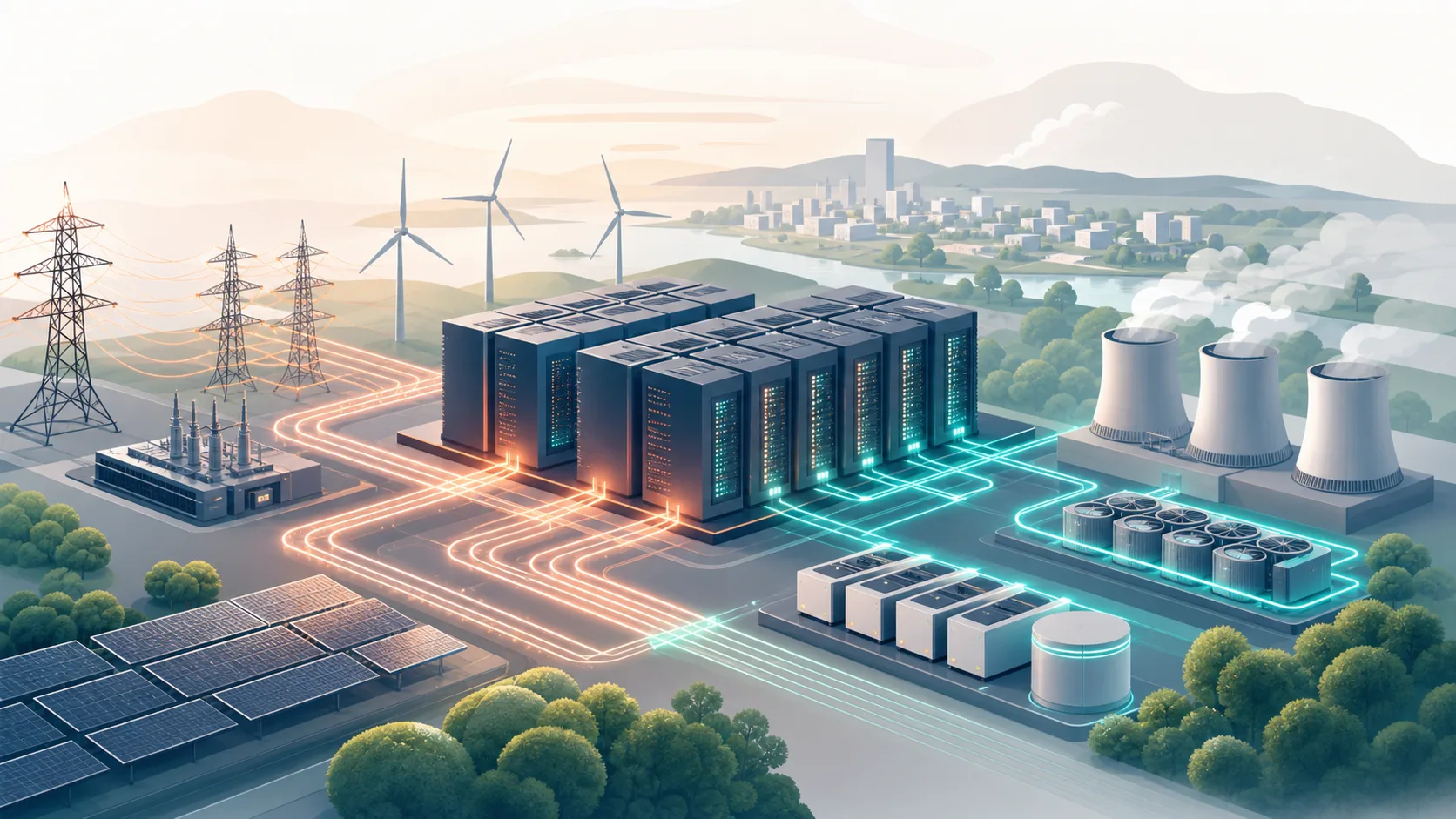
AI news still talks a lot about models, chips and valuations. Fair enough: those things matter. But a quieter part of the story is becoming harder to ignore. The next phase of AI is also about power, cooling, grid connections, local permits, water, transmission lines, batteries and a lot of patient infrastructure capital.
That does not mean every data center headline is proof of an energy crisis. It also does not mean the buildout is harmless just because the technology industry says it can innovate through the problem. The useful middle ground is to read AI infrastructure like infrastructure: with attention to bottlenecks, timelines, who pays, and who carries the local trade-offs.
This is a reading framework, not investment advice or a prediction about any one company. The goal is to make the next AI data center headline easier to parse.
The AI boom moved from software to physical constraints
The first wave of generative AI attention felt mostly digital. New chatbots, new model releases, new coding tools, new creative features. Behind all of that sits a physical stack: chips in servers, servers in buildings, buildings connected to power, power moved through grids, and heat removed through cooling systems.
That physical stack has become part of the business story. Axios reported a new initiative backed by major technology companies to use data centers as test cases for advanced cooling, energy storage and lower-carbon building materials. DigitalBridge and ArcLight framed their planned combination around the convergence of power, AI and digital infrastructure.
The interesting signal is not that these announcements magically solve anything. It is that the industry is openly treating energy and infrastructure expertise as strategic, not as a back-office utility bill.
Power is not just another input
Power behaves differently from cloud software or marketing spend. A company can often add software seats quickly. It cannot always add hundreds of megawatts of reliable electricity in the place and year it wants them.
The International Energy Agency notes that data centers are becoming larger energy-system actors, with AI accelerating demand for high-performance accelerated servers and higher power density. It also emphasizes uncertainty: efficiency may improve, adoption may slow, supply chains may constrain deployment, and local bottlenecks can delay projects.
That uncertainty is the point. When a headline says AI demand is surging, the follow-up question should be: where can the required capacity actually connect to the grid, and on what timeline?
A data center can be built on a faster schedule than transmission lines, substations or new generation capacity. That mismatch creates a practical business constraint. The buyer may want compute now, but the power system may move at the speed of permitting, equipment availability and regional planning.
Cooling and water belong in the same conversation
Power gets the headline because it is easy to count in megawatts. Cooling is less flashy, but it matters. More powerful servers create more heat. Keeping them stable can require different cooling designs, more careful site selection and local scrutiny around water use or heat management.
This is why data center climate initiatives often include cooling, storage and materials in the same bucket. The problem is not one gadget. It is a whole facility design problem.
For readers, a useful test is whether an announcement talks only about renewable energy purchases, or whether it also addresses operating details: cooling method, efficiency, hourly power matching, backup generation, site impacts and coordination with utilities.
Annual clean-energy claims can be meaningful, but they do not automatically answer whether a facility stresses a local grid during peak demand or competes with other local needs. The more local the constraint, the less useful a broad global average becomes.
Capital is chasing the bottleneck
When infrastructure investors talk about AI, the language is different from the usual app-launch language. They talk about generation, transmission, batteries, contracted demand, regulatory relationships and long-duration assets.
That matters because it shows where the bottleneck is moving. If the main constraint were only model quality, capital would cluster around labs and software. If the constraint includes power and physical capacity, capital also moves toward the less glamorous parts of the system.
Still, that does not make every infrastructure bet attractive or every data center project wise. Infrastructure can be durable, but it can also be slow, expensive and exposed to regulation. A project can have real demand and still run into grid queues, local opposition, supply shortages or financing costs.
The better question is not “is AI infrastructure big?” It is “which part of the stack has durable leverage, and which part is simply taking on expensive risk to keep up?”
Local communities are no longer a footnote
AI infrastructure is global as a business story, but local as a lived experience. A data center sits somewhere. It uses a specific grid connection, water system, tax agreement, road, labor pool and regulatory process.
That is why community response matters. Residents may ask whether the project brings jobs, raises electricity costs, uses scarce water, changes land use, or receives public incentives. Those questions are not anti-technology by default. They are normal infrastructure questions.
For an editorial reader, the useful signal is how specific the company gets. A vague promise to support the local community is weaker than clear information about grid upgrades, water use, noise, emergency backup systems, tax treatment and who pays for added infrastructure.
If a project cannot explain its local footprint clearly, the business case is not fully explained either.
How to read the next AI data center headline
A simple checklist helps separate substance from hype.
First, identify the bottleneck. Is the story about chips, power, grid connection, land, cooling, capital, permits or customers? Those are different problems with different timelines.
Second, ask who pays before the payoff arrives. The cost may fall on the company, an infrastructure partner, utility customers, local government, investors or some mix of all of them.
Third, separate annual energy claims from hourly reality. Matching clean energy over a year is not the same as having clean, reliable power available at every hour and every location.
Fourth, watch for local specifics. The stronger announcements usually name practical constraints: substations, transmission, cooling, backup systems, water, community engagement and utility coordination.
Fifth, check whether demand is flexible. Some workloads may shift in time or location more easily than others. Real-time consumer products, model training, batch processing and enterprise inference do not all stress the grid in the same way.
Sixth, look for downside language. Serious infrastructure projects usually discuss risk: delays, regulation, financing, supply constraints and uncertain demand. If every sentence sounds frictionless, the piece may be marketing more than analysis.
The AI story gets more physical from here
AI can still be a software story, a product story and a market story. But it is increasingly an infrastructure story too. The companies that build, finance, regulate and host AI capacity are dealing with constraints that cannot be solved by a better demo alone.
That should make readers a little more careful with easy narratives. “AI demand is booming” is not enough. Booming demand can create winners, but it can also expose bottlenecks, local resistance and capital mistakes.
A better lens is more grounded: where does the power come from, how fast can the grid adapt, what has to be cooled, who pays for the upgrade, and what does the local community actually get?
That lens makes AI infrastructure less magical. It also makes it easier to understand.