
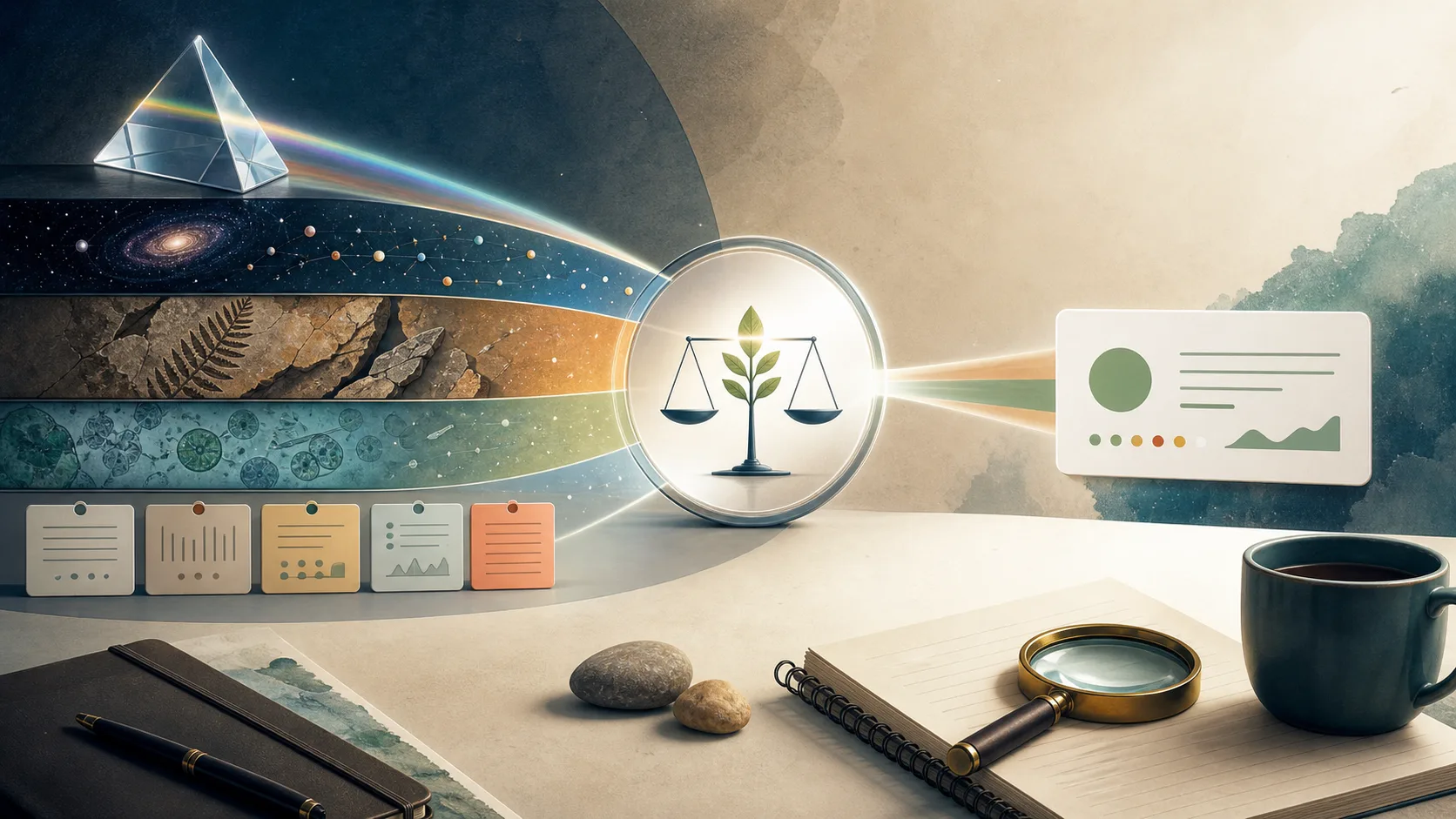
Science news has a headline problem. Not because science is boring, but because real research is usually careful, narrow and full of caveats, while headlines are built to make you click now.
In one news cycle, you can see a primitive galaxy from the early universe, a new dinosaur fossil, ancient teeth that complicate human-family history, unusual crystals from a nuclear test, a genetics story about ancestry and a survey showing that physicists disagree on big questions. Each item may be genuinely interesting. The trouble starts when every item is framed as a revolution.
The useful habit is not cynicism. It is learning to slow down for a few checks before deciding what a discovery means.
Start with the type of evidence
Not all scientific evidence does the same job. A fossil find, a DNA analysis, a telescope observation, a lab experiment and an expert survey all answer different kinds of questions.
A fossil can add a missing piece to a timeline, but it rarely rewrites a whole field by itself. A genome study can reveal patterns across populations, but those patterns still need careful interpretation. A telescope image can show an object in remarkable detail, while the explanation of that object may depend on models, assumptions and follow-up observations.
Before reacting to a big headline, ask: what is the evidence here? Is it a direct measurement, a model, a lab result, a survey, an observation or a first report from a small sample?
That one question already filters out a lot of hype.
Separate “new” from “settled”
Science advances by adding new constraints, not by producing a final answer every Thursday.
A new paper can be strong and still be early. It can narrow a debate without ending it. It can challenge an older story without replacing it with a complete new one. This is especially true in fields such as human origins, cosmology, particle physics and evolutionary biology, where the evidence is often partial and the systems are hard to reconstruct.
So when a headline says a discovery “changes everything,” translate that into a calmer question: what did this finding change for specialists?
Maybe it changes a date range. Maybe it adds a population group to a migration model. Maybe it gives researchers a cleaner way to test an old hypothesis. Those are real contributions. They just are not always the same thing as a public-facing scientific earthquake.
Look for the scale of the claim
Good science headlines should make the scale visible. Did researchers find one specimen, analyze thousands of genomes, run a controlled experiment, or observe a distant object with a new instrument?
Scale does not automatically mean quality. A small sample can be valuable if the object is rare. A large dataset can still be interpreted too aggressively. But scale helps you understand how far the claim can travel.
For example, a rare crystal can tell scientists something specific about extreme conditions. That does not mean it changes everyday chemistry. A newly described dinosaur can reshape the regional fossil record. That does not mean every dinosaur family tree is now wrong. A study of a distant galaxy can sharpen a picture of the early universe. That does not make the universe simple.
The more specific the evidence, the more careful the conclusion should be.
Check whether the article explains uncertainty
Uncertainty is not a weakness in science writing. It is part of the product.
A good article will usually tell you what researchers know, what they infer and what remains open. It will mention limitations without burying them. It may include disagreement from other experts, especially when the claim touches a lively debate.
Be more cautious when a story moves straight from “researchers found X” to “this proves Y” without explaining the path between them. The interesting part is often in that path: the method, the comparison group, the model, the margin of error and the alternative explanations.
If the article cannot explain how the researchers got from evidence to conclusion, treat the conclusion as provisional.
Peer review helps, but it is not magic
A paper in a serious journal matters. It means the work passed a formal review process and is visible to other specialists. That is much better than an unsupported claim.
But peer review is not a guarantee that every interpretation is final. Other researchers still need to respond, replicate where possible, test related predictions and fit the result into the wider body of evidence. Some fields move through direct replication; others rely on converging evidence because the original event cannot be repeated, such as the formation of an ancient galaxy or the life of an extinct animal.
The practical takeaway is simple: treat peer-reviewed findings as more credible than loose claims, but do not treat one paper as the end of the story.
Watch for the practical jump
Science headlines often leap from discovery to impact. A new processor for spacecraft becomes autonomous exploration. A materials breakthrough becomes future quantum devices. A biological insight becomes a hint about health, behavior or identity.
Those links may be fair, but they are usually not immediate. Between discovery and practical use, there are engineering problems, cost problems, safety tests, repeatability questions and many boring years of refinement.
When an article gestures toward a future application, ask whether that application exists now, is being tested, or is simply a plausible long-term direction. All three can be interesting. They should not be treated the same.
A quick reading checklist
Use this when a science story sounds dramatic:
- What kind of evidence is behind the claim?
- Is the finding new, settled, or one step in an active debate?
- How large and representative is the sample or observation?
- Does the article explain uncertainty and limitations?
- Are independent experts quoted or is the story only repeating a press release?
- Is the practical impact current, near-term, or speculative?
- What would need to happen next for the claim to become stronger?
This checklist is not meant to drain the fun from science news. The fun gets better when the signal is clearer.
The better way to be curious
The right response to a big science headline is not “believe it” or “dismiss it.” It is “interesting, now what is the evidence?”
That mindset keeps room for wonder without giving every headline a free pass. It lets a fossil be exciting without turning it into a total rewrite. It lets a galaxy observation be beautiful without pretending the whole universe has been solved. It lets disagreement among experts be a sign of an active field, not a failure.
Science is allowed to be dramatic. Our reading of it should be a little calmer.